
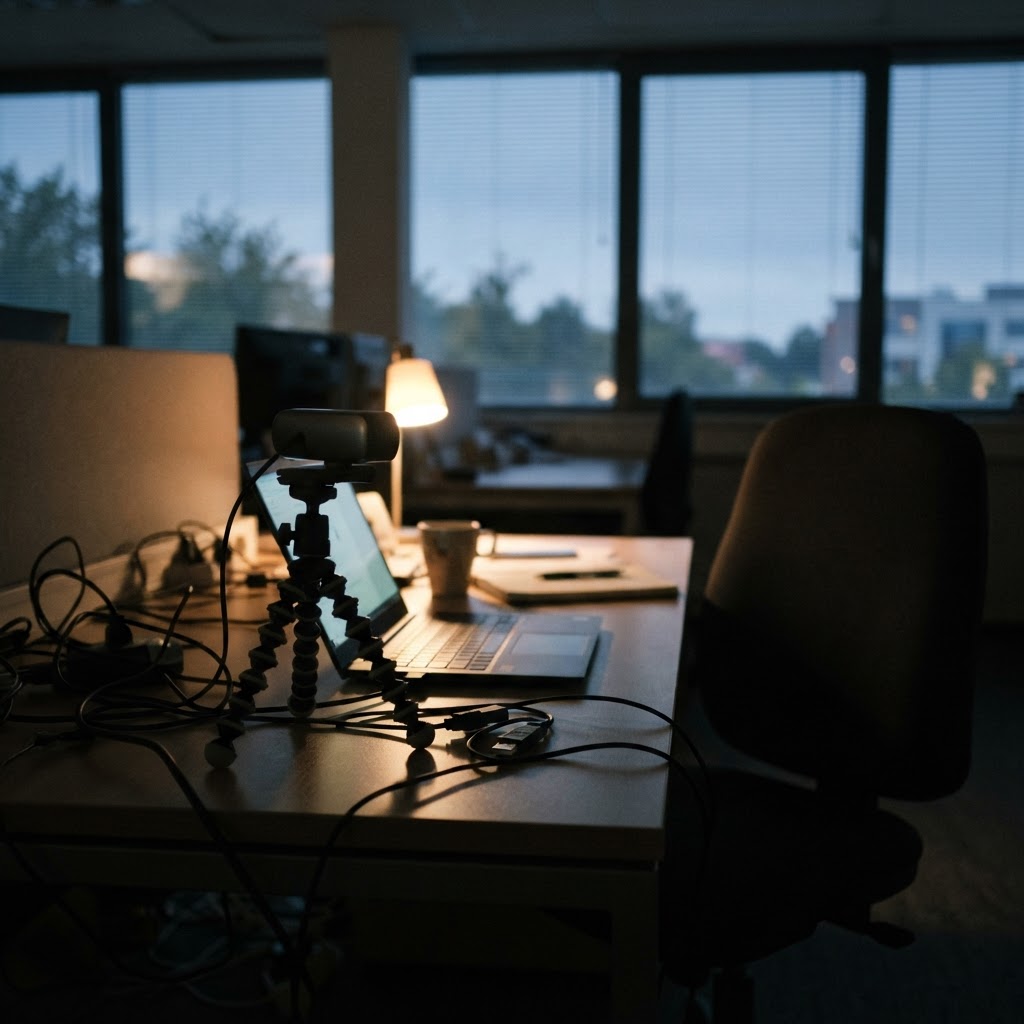
Video notarization solved the wrong half of the problem. It proved that two people could see each other. It never proved who they were.
When we published our case for the agentic notary in May, one claim drew more pushback than any other: that the next era of notarization would not be a video call. Fair enough. Video is the most visible thing happening in this industry, and the assumption that it is also the destination has gone largely unchallenged.
So here is the argument in full. Live video is not the future of notarization. It is a transitional technology — an expensive, human-synchronous detour around a problem that better tools already solve.
What the webcam was actually for
Remote notarization exists to answer one question: when a signer and a notary are not in the same room, how do you know the person signing is the person named on the document?
Video answers it with presence. Two humans look at each other through cameras, one holds up an ID, a recording is made. It feels rigorous because it resembles the ritual it replaced.
But presence is not proof. Holding a document to a webcam proves that someone is holding a document to a webcam. It does not establish that the signer is who they claim to be. That work is done by the identity-proofing steps layered underneath the call, which makes video the most expensive part of the process and the least load-bearing.
The bill for live video
Video notarization is not a free upgrade to a paper process. It is a new cost center, and the costs compound:
- Per-session platform fees. Remote notarization vendors charge per notarization, and those fees stack on top of the notary's own fee.
- Two schedules, one moment. A live session requires signer and notary to be available at the same time. Reschedules, missed slots, and time-zone gaps are not edge cases; they are the normal failure mode.
- Recording retention. Most remote notarization rules require the audio-video recording to be stored, encrypted, and retrievable for years. That is storage, legal hold, and retrieval work that never ends.
- Signer-side friction. Bandwidth, cameras, unfamiliar portals, and digital literacy all become prerequisites. The signers who need us most, elderly clients, memory care residents, and rural families, are the least equipped to satisfy them.
All of that apparatus exists to observe a signature.
What knowledge-based authentication does instead
Knowledge-based authentication, or KBA, proves identity by asking questions only the real person should be able to answer: a former street address, a previous lender, an older phone number. The questions are generated from credit-header and public-record data, so the answers are not guessable and not findable on a social profile.
Pair KBA with credential analysis (checking the security features of the ID itself) and a liveness capture, and you have proofing that is asynchronous, machine-readable, and cheap:
- No scheduling. The signer completes verification whenever they are ready, on the phone they already own. No camera setup. No portal walkthrough.
- A deterministic audit trail. Pass, fail, score, timestamp, and the data sources queried. Compare that to a recording a human must watch and interpret years later.
- Costs that fall instead of climb. Identity proofing runs a few dollars per signer. A live video session runs into the tens of dollars once the platform fee, the notary's blocked hour, and retention are counted.
- Standards alignment. Federal identity-proofing guidance treats proofing as document and data verification, and most state remote-notarization rules already require KBA and credential analysis alongside the video session. The webcam was never doing the verifying. KBA was.
Why this is the unlock for agentic notarization
An agent cannot sit on both ends of a video call. Video is the least automatable step in the entire ceremony: it needs two humans, at once, with working cameras.
KBA is the opposite, a gate a machine can open or close. An agent can start a verification, read the result, apply policy (pass, proceed; fail, route to a human), write the journal entry, and notify everyone involved without waking anybody up. The constraint moves from scheduling to policy, and that is a real step change. Video never removes the bottleneck. It industrializes it.
What we are not claiming
Two honest caveats.
First, KBA is not a legal substitute for personal appearance. In California, physical presence remains the standard, and an in-person commissioned notary stays the gold standard until the law says otherwise.
Second, KBA alone is not enough. Thin-file signers, including young adults, recent immigrants, and anyone outside the credit system, can fail out-of-wallet questions through no fault of their own. That is why proofing has to be layered: KBA, plus document forensics, plus liveness, plus a fast human fallback when a good-faith signer gets locked out. Federal guidance is openly skeptical of KBA as a standalone method. It is a component, not a cure.
The quiet ceremony
The future of notarization is not a scheduled video appointment. It is an asynchronous, machine-verifiable ceremony: identity proofed at the gate, the signing witnessed and journaled, a commissioned human as the authority of record, and a face available on request for the cases that genuinely need one.
Alamo Notary is building for verification rather than spectacle, because verification is what the law actually asks for and what clients actually need.